
Are VPNs Legal? VPN Restrictions by Country: A Global Guide for 2026
Legal note: This article is general information, not legal advice. Laws and enforcement can change quickly.
Are VPNs legal?
VPNs are legal for ordinary personal and business use in most countries, but some governments restrict unapproved services, block VPN traffic, impose data-retention requirements, or penalize certain uses. The most important distinction is between a country where VPNs are generally permitted, one where only approved VPN services are allowed, one where connections are technically blocked, and one where personal use can carry serious legal risk.
A VPN does not exempt you from local law. Using one to protect a connection is legally different from using it to commit an offence, and a country can restrict VPN providers without explicitly criminalizing every individual user. The legal and technical situation must therefore be assessed separately.
TL;DR: VPN legality by country
- Generally legal: The United States, United Kingdom, Canada, and most European countries permit ordinary VPN use.
- Legal, but subject to important conditions: India has data-retention and reporting requirements for covered VPN providers; the UAE distinguishes legitimate business VPN use from services intended to bypass ISP filtering.
- Restricted or filtered: China, Russia, Iran, and Türkiye restrict certain VPN services or traffic, although the precise rules and enforcement differ.
- High-risk or reportedly prohibited: Countries such as Belarus, North Korea, and Turkmenistan are commonly identified as jurisdictions where VPN use is prohibited or exceptionally risky. Myanmar also presents serious legal and technical risks.
- Technical blocking is not the same as illegality: A VPN connection can fail because of network filtering, protocol detection, an ISP outage, or a blocked server, even when using a VPN is not itself prohibited.
These are broad classifications, not a substitute for checking the current law and local advisories before travelling or connecting. Country guides sometimes disagree because they use different definitions of “illegal,” “restricted,” and “blocked.”
1. VPN restrictions by country: global matrix
The matrix below focuses on countries frequently discussed in connection with VPN restrictions. It is not an exhaustive list of every country and does not assign a legal conclusion where the available evidence does not support one.
Last verified: October 14, 2026, for the editorial review of this guide. The date indicates when this article's classifications were reviewed; it does not mean every law or enforcement action was independently reconfirmed with a local lawyer on that day.
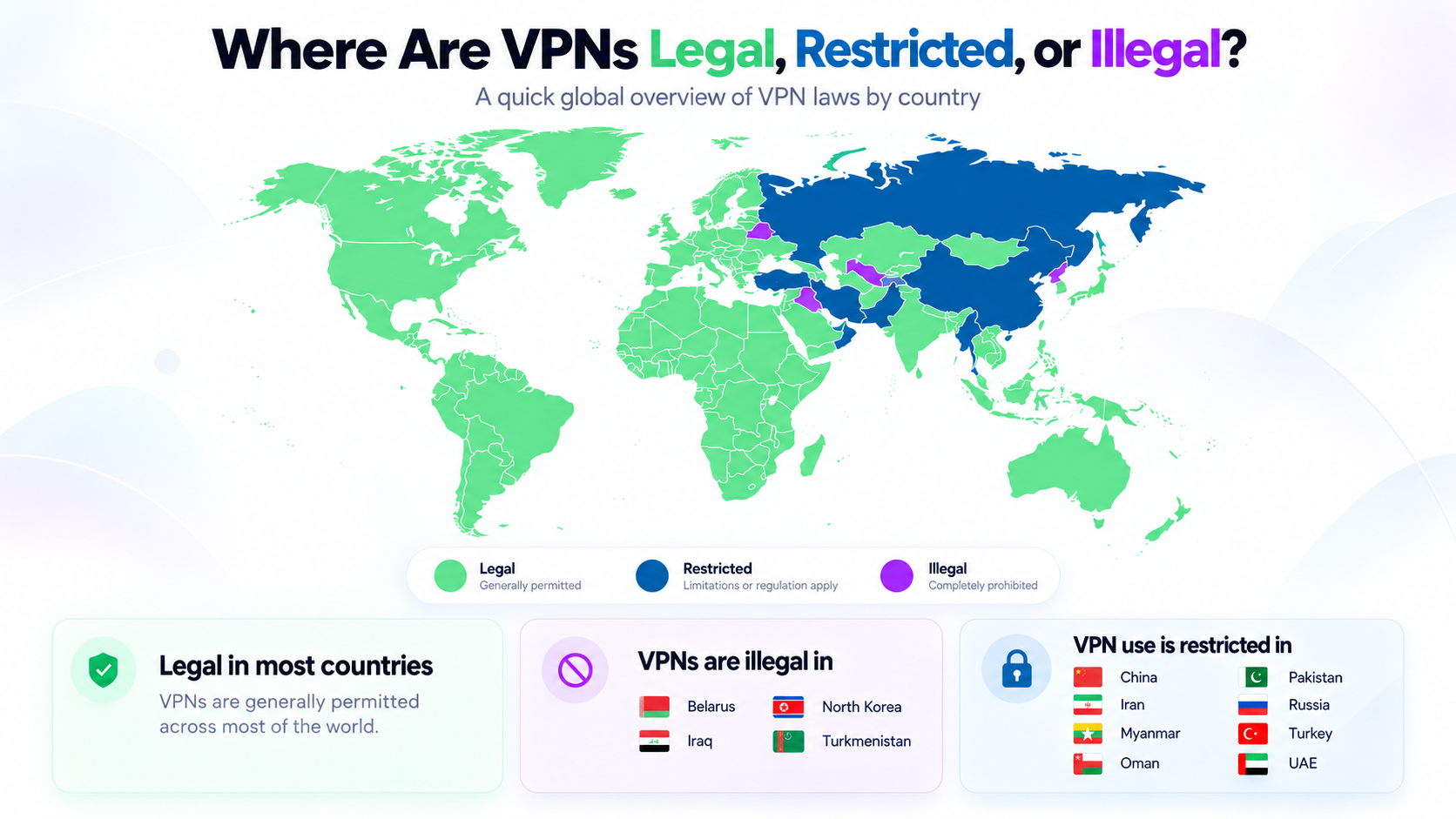
|
Country |
Classification |
What users should know |
Source and last verified |
|---|---|---|---|
|
United States |
Generally legal |
Personal and business VPN use is broadly lawful. A VPN does not legalize prohibited activity, and individual state or federal rules may apply to the underlying conduct. |
Global VPN legality overview — Oct 14, 2026 |
|
United Kingdom |
Generally legal |
VPNs are widely used for privacy and security. Separate online-safety and age-assurance rules may affect how services operate or how platforms handle access; do not assume those rules amount to a blanket VPN ban. |
Internet Society: VPN Restrictions — Oct 14, 2026 |
|
Canada |
Generally legal |
Ordinary personal and corporate VPN use is broadly permitted. Normal criminal and civil laws continue to apply when a VPN is used. |
Global VPN legality overview — Oct 14, 2026 |
|
Lithuania |
Generally legal |
Lithuania is an EU member state. Ordinary VPN use is broadly permitted; VPN use does not override Lithuanian law or applicable EU obligations. |
Global VPN legality overview — Oct 14, 2026 |
|
Germany |
Generally legal |
Personal and business VPN use is broadly permitted. The legality of the underlying online activity is a separate question. |
Global VPN legality overview — Oct 14, 2026 |
|
India |
Legal with provider obligations |
VPNs are not generally banned for individual users, but CERT-In's 2022 directions impose specified record-keeping, customer-information, and incident-reporting duties on covered providers. Some providers have removed physical servers from India rather than operate under those requirements. |
CERT-In directions — Oct 14, 2026 |
|
China |
Restricted; technical blocking |
The regulatory framework restricts unauthorized cross-border VPN services, and popular VPN services or protocols may be blocked. The treatment of individuals, businesses, and approved services is not identical; do not interpret a working connection as legal approval. |
Top10VPN global guide — Oct 14, 2026 |
|
Russia |
Restricted; technical blocking |
Authorities restrict VPN services that do not comply with government requirements and block many services. Rules also target promotion of VPNs and information about circumventing internet blocks. |
Freedom House: Russia — Oct 14, 2026 |
|
Iran |
Restricted; high risk |
Authorities have criminalized the use of unauthorized VPNs. Enforcement, access restrictions, and the practical risks can change; do not assume an unapproved VPN is lawful because it connects. |
Freedom House: VPN restrictions — Oct 14, 2026 |
|
Türkiye (Turkey) |
Restricted services; technical blocking |
VPN use is not generally treated as an outright blanket offence, but authorities have blocked multiple VPN providers. Availability can change by provider, ISP, and protocol. |
Freedom House: VPN restrictions — Oct 14, 2026 |
|
United Arab Emirates |
Conditional; high-risk use cases |
The UAE Telecommunications and Digital Government Regulatory Authority distinguishes corporate VPN use for internal networks from VPN services intended to bypass ISP filtering. Penalties can depend on the purpose and underlying conduct, so broad claims that “all VPN use is illegal” are misleading. |
Global Law Experts — Oct 14, 2026 |
|
Myanmar |
Highly restricted; high risk |
VPN blocking has been documented, and the 2025 Cybersecurity Law introduced further restrictions affecting VPN providers and data retention. Users may face both connectivity and legal risks. |
Freedom House: Myanmar — Oct 14, 2026 |
|
Belarus |
Prohibited or severely restricted; high risk |
VPN and circumvention-tool restrictions have been enforced, including network-level blocking. The practical risk can be particularly serious during politically sensitive periods. |
Freedom House: VPN restrictions — Oct 14, 2026 |
|
North Korea |
Extreme restrictions; high risk |
General internet access is itself heavily restricted for most residents. Consumer VPN assumptions from other countries do not apply, and independent verification of ordinary personal VPN use is extremely limited. |
Global VPN legality overview — Oct 14, 2026 |
|
Turkmenistan |
Prohibited or severely restricted; high risk |
VPN services and circumvention tools are widely reported to be prohibited or blocked. The restrictive internet environment makes both legal and technical access uncertain. |
Global VPN legality overview — Oct 14, 2026 |
|
Oman |
Restrictive; verify the applicable authorization rules |
Some guides classify personal VPN use as prohibited or limited to authorized use, while the details depend on the service and applicable telecommunications rules. Do not rely on a generic “VPNs are legal” statement without checking current local requirements. |
Oman Observer — Oct 14, 2026 |
|
Iraq |
Legally unclear; elevated caution |
Sources differ on whether Iraq has a formal nationwide VPN prohibition or primarily restricts VPN traffic. Because the legal position and enforcement may be opaque, treat this as uncertain rather than stating an unqualified ban. |
Top10VPN global guide — Oct 14, 2026 |
How to interpret the table: “Generally legal” does not mean every use is lawful. “Restricted” does not automatically mean every individual user faces the same penalty. “Technically blocked” describes network behaviour, not necessarily the law. For high-risk jurisdictions, consult current official travel advice and local legal guidance before using a VPN.
Important source limitation
The table combines official regulatory material with specialist country-by-country research. Some jurisdictions publish clear rules for providers but little reliable detail on how ordinary individual users are treated. In those cases, the table deliberately uses qualified language rather than inventing a penalty, asserting a blanket ban, or implying that enforcement is uniform.
For the UAE, the TDRA's own guidance is especially important because it expressly addresses VPN services used to bypass ISP filtering. For India, CERT-In's published directions are the primary source for the provider obligations summarized above.
2. What do VPN restrictions actually restrict?
A law or government order may target different parts of the VPN ecosystem. Understanding the target helps explain why a service might work on one network and fail on another.
A. VPN providers and authorization
A government may require a provider to register, obtain authorization, or comply with state-directed filtering. An approved service may be permitted for corporate use while independent consumer VPN services face restrictions.
This is why the phrase “VPNs are legal in China” or “VPNs are illegal in China” can be too simplistic. The relevant questions include which service is used, whether it is authorized, what it is used for, and which rules apply to the user.
B. VPN apps and websites
Authorities can remove apps from local app stores, block provider websites, or restrict access to VPN downloads. These measures can make it difficult to install or update a service without necessarily preventing every existing connection.
C. Server IP addresses and protocols
Network operators can block the IP addresses associated with VPN servers, restrict known protocol traffic, or identify patterns associated with encrypted tunnels. A provider may therefore be available in an app store but unable to connect reliably from a particular network.
D. Particular uses of a VPN
Some rules focus on the purpose of VPN use or the content being accessed rather than simply on installing a VPN. The UAE's published guidance, for example, distinguishes corporate VPN technology from services that allow users to bypass ISP filtering. Russia's restrictions have also targeted VPN promotion and information about circumventing blocks.
3. Why do VPNs get blocked? DPI, IP filtering, and protocol detection
VPN traffic can be disrupted through several technical mechanisms. The three most relevant are IP blocking, protocol or traffic-pattern detection, and deeper inspection of network traffic.
IP address blocking
A network blocks known IP addresses associated with VPN servers. Providers may add or change infrastructure, but replacement addresses can also be discovered and blocked.
Deep Packet Inspection (DPI)
DPI systems examine traffic characteristics and, depending on the system and encryption, selected packet metadata or content. Even where payloads are encrypted, traffic patterns and protocol signatures can sometimes be used to identify or classify connections.
Protocol and traffic-pattern blocking
A network can target recognizable connection handshakes, ports, or recurring traffic patterns. A protocol that connects reliably on one ISP may fail on another if their filtering policies differ.
These methods are not interchangeable, and a failed connection does not prove which method is responsible. An outage, overloaded server, routing problem, or app configuration can produce similar symptoms. Research on Russia, for example, documents both VPN service blocking and restrictions targeting particular protocols.
Does using a different VPN protocol help?
Sometimes, but there is no universal solution.
A different protocol may use different connection patterns or be affected differently by a network's filters. Some services offer protocols designed for more difficult network environments, but performance depends on the local ISP, the filtering system, server availability, and the specific implementation.
A protocol that works today may stop working after network rules change. No VPN protocol can guarantee access in every restricted network, and technical connectivity does not establish legal permission.
For a deeper technical explanation, read our related guide on Deep Packet Inspection (DPI) and our explainer on VLESS and connectivity in restrictive networks.
4. Is using a VPN legal if you are travelling?
Travelling does not automatically exempt you from the laws of the country you enter. A VPN that you use lawfully at home may be restricted at your destination, and a service that connects successfully may still be subject to local rules.
Before travelling:
- Check current official advice. Look for government travel advisories, telecommunications regulator guidance, and relevant legislation.
- Check the exact rule. Is the restriction aimed at individuals, providers, unapproved services, certain content, or specific uses?
- Consider work requirements. A corporate VPN may be treated differently from a consumer privacy service, but do not assume that corporate use is automatically exempt.
- Understand the consequences. If the law or enforcement practice is unclear, consult a qualified local source rather than relying on a provider's marketing page.
- Prepare securely. Keep software updated and use reputable security tools. Do not treat a VPN as a substitute for device security or legal advice.
If you are already in a jurisdiction with strict controls, avoid experimenting with unknown VPN apps or configuration files. A service that promises guaranteed access may not be trustworthy, and installing unfamiliar software can create additional security risks.
5. What happens if you use a VPN where it is restricted?
Consequences depend on the country's laws and enforcement practices. Possible outcomes include:
- A VPN website or app being blocked.
- An existing connection becoming unreliable or unavailable.
- An app being removed from a local store.
- A provider being ordered to comply with filtering, data-retention, or registration requirements.
These outcomes are not equivalent. A blocked connection does not automatically mean the user has committed an offence, and the absence of a connection failure does not prove the user is compliant.
Avoid relying on viral social media posts or outdated country lists for legal conclusions. Where the consequences could be serious, check the underlying rule and seek local legal advice.
6. Can a VPN make illegal activity legal?
No. A VPN changes how your internet connection is routed and can help protect data in transit, but it does not remove the laws that apply to your actions.
For example, a VPN does not automatically legalize fraud, harassment, unauthorized access to systems, or the distribution of unlawful material. Nor does it necessarily override platform terms, age-assurance requirements, court orders, or local restrictions.
A VPN's privacy and security benefits should be assessed separately from the legality of a particular activity. Likewise, an app's privacy policy or no-logs claim is not proof that using the app is authorized in every country.
7. How to choose a VPN when privacy and reliability matter
For countries where ordinary VPN use is permitted, focus on security and transparency rather than claims that a service can defeat every restriction.
Look for:
- A clear privacy policy: Understand what connection data is collected, how long it is retained, and under what circumstances it may be disclosed.
- Independent assessments: Check what was actually assessed, by whom, and when. An audit or certification has a defined scope; it is not a guarantee of every aspect of a product.
- Modern encryption and secure implementation: A VPN should protect traffic between your device and its VPN endpoint.
- Transparent ownership and support: You should be able to identify the provider and find its support and privacy documentation.
- Honest protocol information: Understand which protocols are available and what their limitations are.
- No absolute promises: Claims such as “works everywhere,” “cannot be detected,” or “100% anonymous” should be treated with skepticism.
What about Octohide VPN?
Octohide VPN is designed to provide an accessible VPN option with privacy and security features, including a no-browsing-logs policy and RAM-based servers. It supports multiple connection protocols, including WireGuard and VLESS, with the aim of offering flexibility across different network conditions.
VLESS may help with connectivity in some difficult network environments, but results vary by location, network, and current filtering. Octohide VPN does not guarantee that a connection will work in every country or that its use is permitted under every local law. Users should check applicable rules before connecting in a jurisdiction that restricts VPNs.
Learn more at Octohide VPN.
8. Frequently asked questions
Are VPNs legal worldwide?
No single answer applies worldwide. VPNs are generally legal for ordinary personal and business use in most countries, while others impose restrictions, block services, or prohibit unauthorized use. Check the rules for the specific country.
Which countries restrict or block VPNs?
Countries frequently identified in specialist VPN research include China, Russia, Iran, Türkiye, and Myanmar. The nature of the restrictions differs: some target providers or protocols, while others impose broader limits on unauthorized VPN use. Belarus, North Korea, and Turkmenistan are commonly reported as especially restrictive jurisdictions. Verify current rules before travel or use.
Are VPNs legal in Europe?
VPNs are generally legal for ordinary use across most European countries. However, national laws still apply to online activity, and local rules or enforcement can change. Do not assume that every European jurisdiction has identical rules.
Is using a VPN illegal in India?
VPN use is not generally banned for individual users, but India's CERT-In directions impose specified information-retention and reporting obligations on covered VPN providers. These provider obligations are important when evaluating a service's privacy model.
Are VPNs legal in China?
The position is restricted and depends on the service, authorization, purpose, and applicable rules. Unauthorized services and VPN traffic can be blocked. Do not interpret a successful connection as proof that the service or use is legally authorized.
Are VPNs legal in the UAE?
VPN technology is permitted for certain legitimate purposes, including corporate access to internal networks. The UAE's TDRA warns against VPN services used to bypass ISP filtering, so the purpose and applicable law matter.
Can my ISP tell that I am using a VPN?
Depending on the protocol and network, an ISP may be able to infer or identify VPN use from connection metadata, recognizable protocol handshakes, or traffic patterns. Encryption protects the contents of traffic in transit but does not make every aspect of a connection invisible.
Can a VPN bypass government blocking?
Some VPN connections may remain available when other services are blocked, but this depends on the local network, protocol, server, and filtering method. VPNs can also be blocked. No provider can responsibly guarantee universal access, and technical capability does not determine legality.
Does a VPN protect me from local laws?
No. A VPN is a network privacy and security tool, not legal immunity. You remain subject to applicable laws and regulations.
Conclusion: check the law and the network separately
VPN legality is not a simple global yes-or-no question. In most countries, ordinary VPN use is permitted, but some governments restrict providers, require compliance with surveillance or filtering rules, block VPN traffic, or impose serious penalties for unauthorized use.
When evaluating a country, ask three separate questions: Is personal VPN use lawful? Are the service or provider restricted? And can the connection actually work on the local network? Keeping those questions separate leads to a more accurate understanding than a single list of “VPN-banned countries.”
For privacy-conscious users, the best approach is to choose a transparent provider, understand its limitations, and verify current local requirements before connecting.